See ORAYA at work.
Five short films, recorded on the real applications: a clinical question answered end to end, ORAYA in the visit, outside records turned into chart data, the patient app, and Oraya Study.
One clinical question, end to end
A clinician asks a question about a patient. ORAYA reads the record, works through the evidence, and returns a graded answer with every source cited.
2:06ORAYA in the visit, beside the EHR
ORAYA listens to the visit, reasons through the differential as it unfolds, and drafts the note for the clinician to review and sign.
1:25Autosync: outside records to chart data
An outside record arrives. ORAYA reads it, checks it belongs to the right patient, and lays out each value with its source, for the clinician to confirm before anything is added.
1:18MyORAYA, the patient app
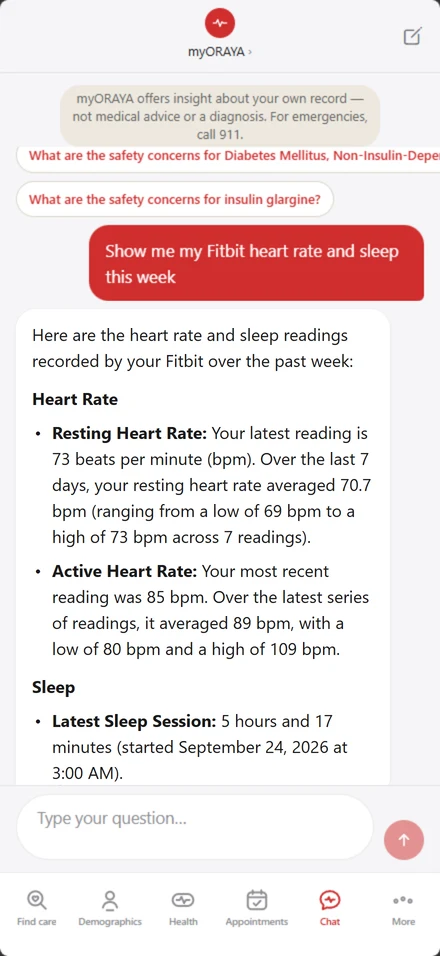
Patients find care, read their health summary and medications, book visits, and ask questions answered from their own record.
1:37Oraya Study, for medical students
A learner builds a cited study guide, reviews its flashcards, drills a board-style vignette, asks the tutor, and turns notes into cards, with progress tracked by confidence.
1:58Built around how clinicians check their work.
Four capabilities, one answer view. Each part of a real ORAYA answer.
 01 / 04
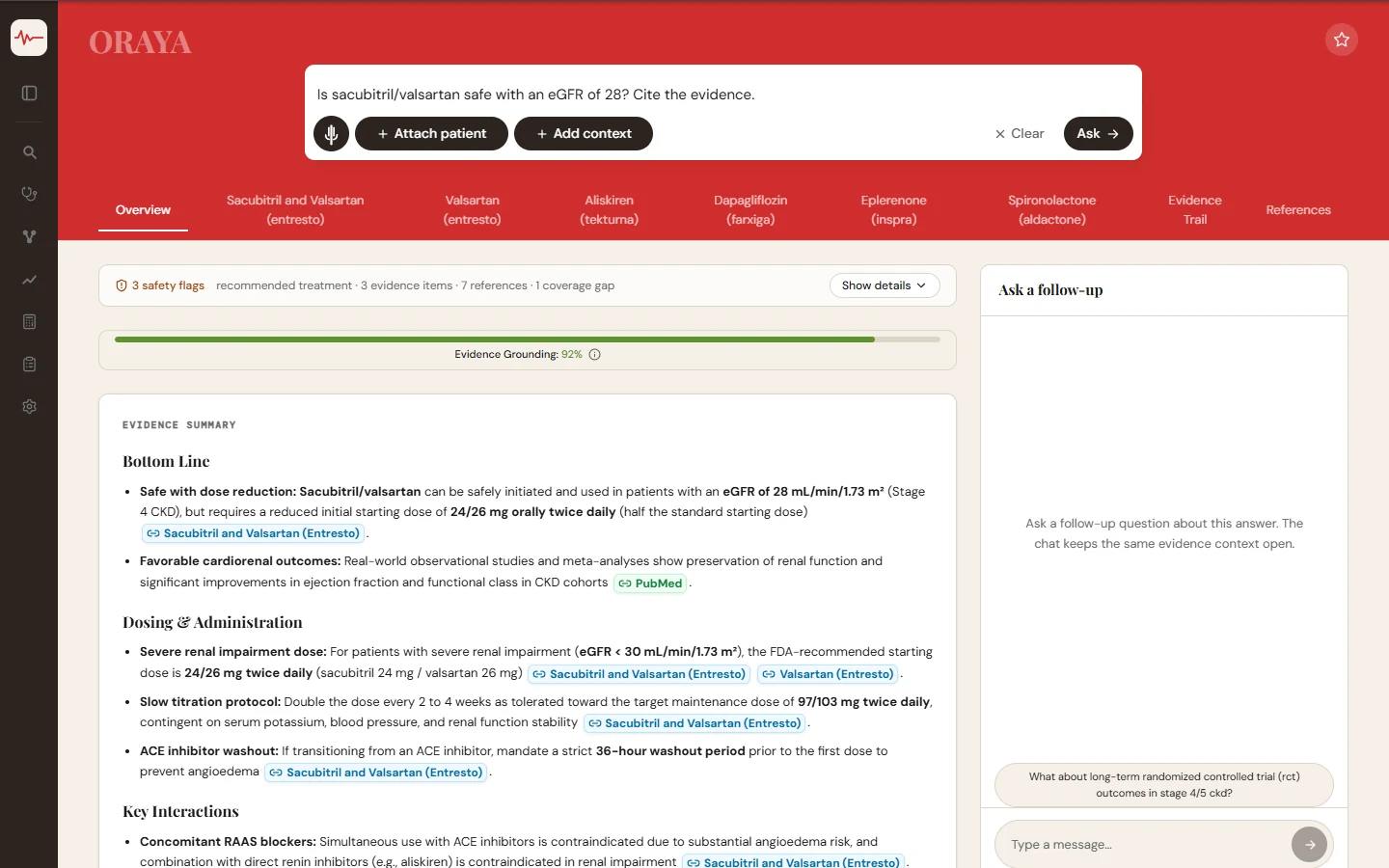
Ask in plain language. Get the evidence back.
A question about dosing, safety, or treatment returns a structured answer, with each point linked to the FDA label, study, or guideline it came from.
- Bottom line, dosing, and key interactions
- Safety flags and coverage gaps called out
- Follow-up questions keep the same evidence open
 02 / 04
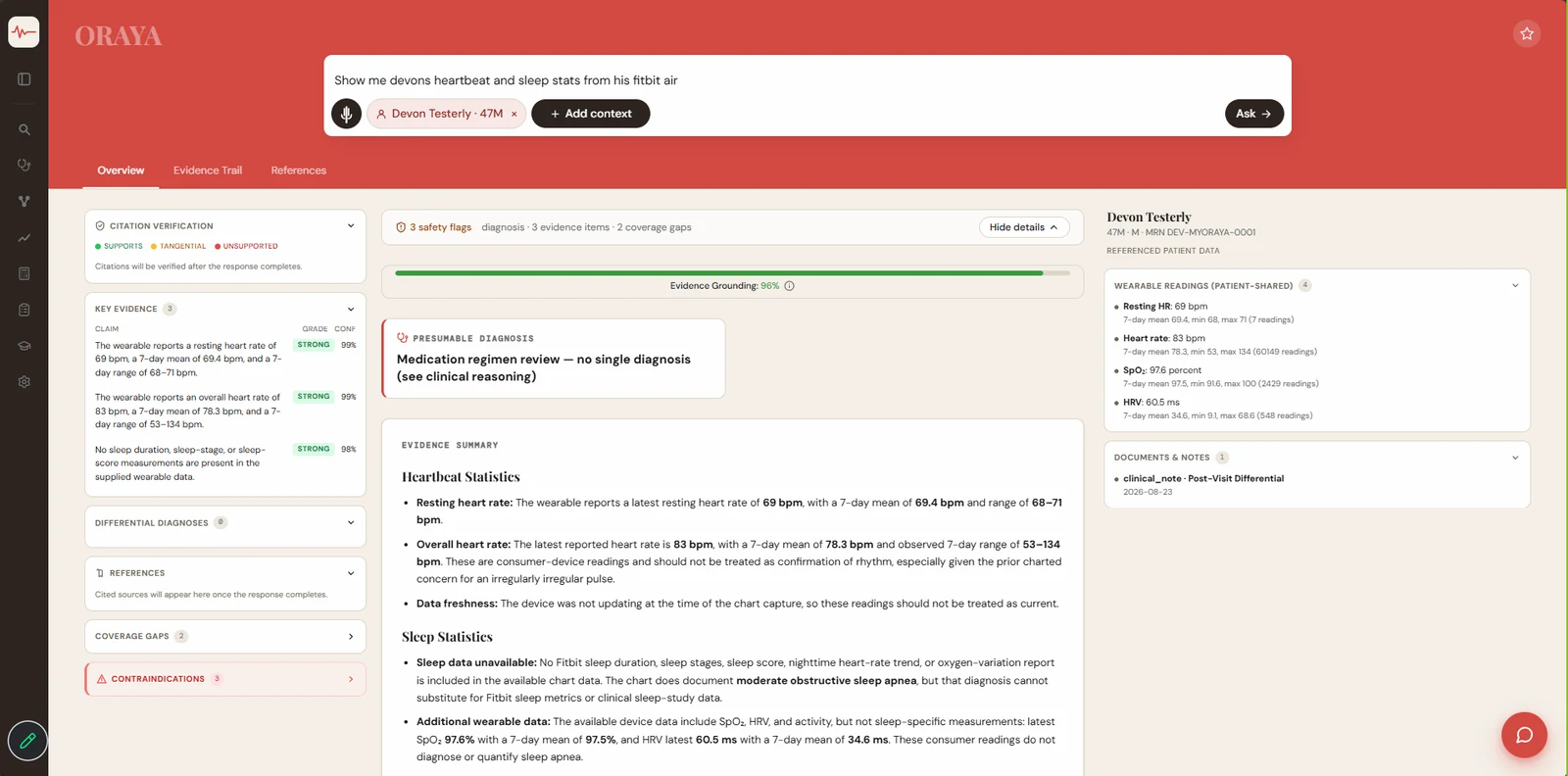
See how strong the support is.
Claims are graded for strength and confidence, and every citation is checked as supporting, tangential, or unsupported before you rely on it.
- Claim-level grade and confidence
- Citation verification on every source
- Contraindications surfaced alongside
 03 / 04
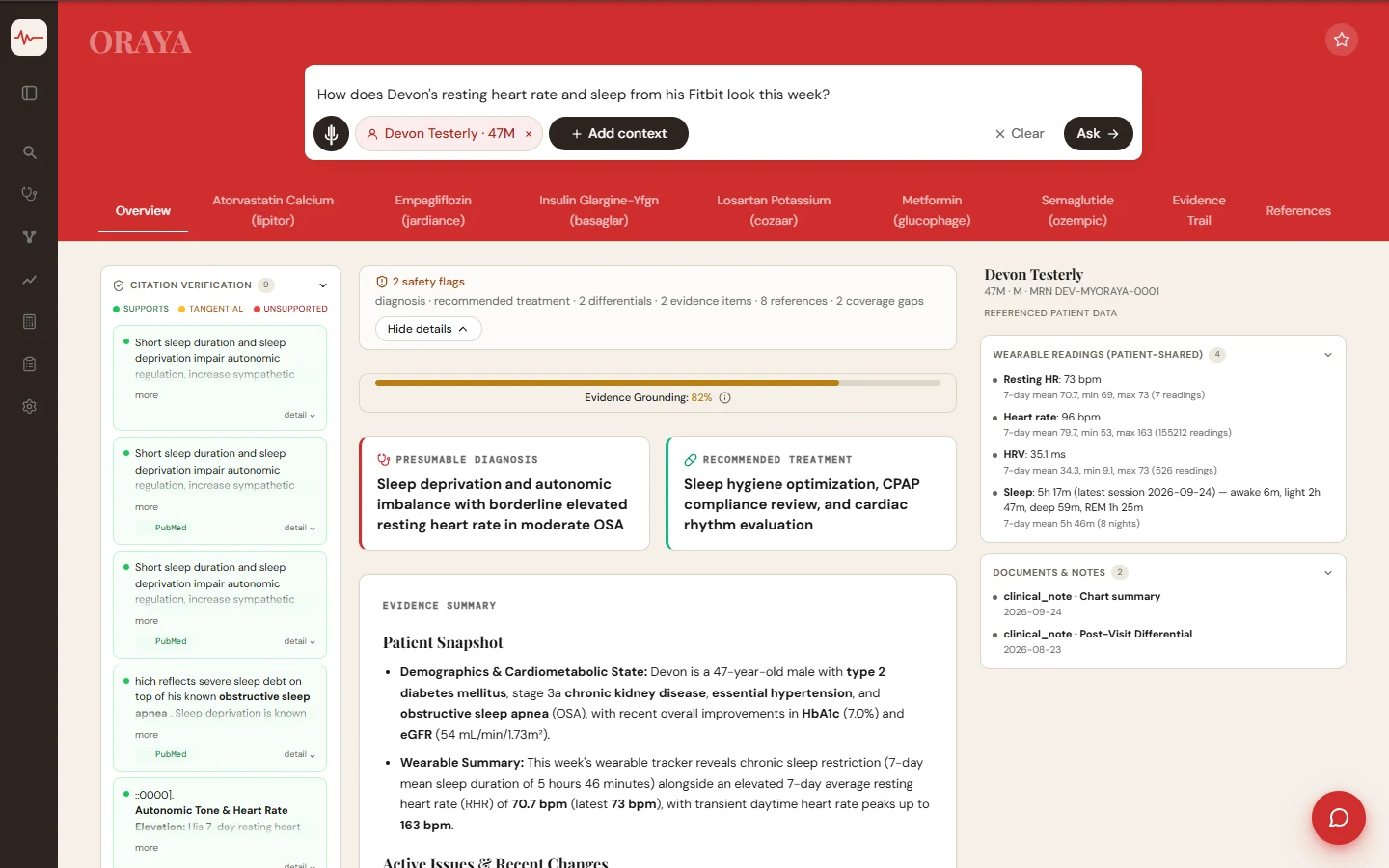
Bring the patient into the reasoning.
Attach a patient and ORAYA works from their chart: conditions, medications, labs, notes, and wearable readings the patient has chosen to share.
- Presumable diagnosis and recommended treatment
- Referenced patient data shown beside the answer
- Tabs for each medication on the chart
 04 / 04
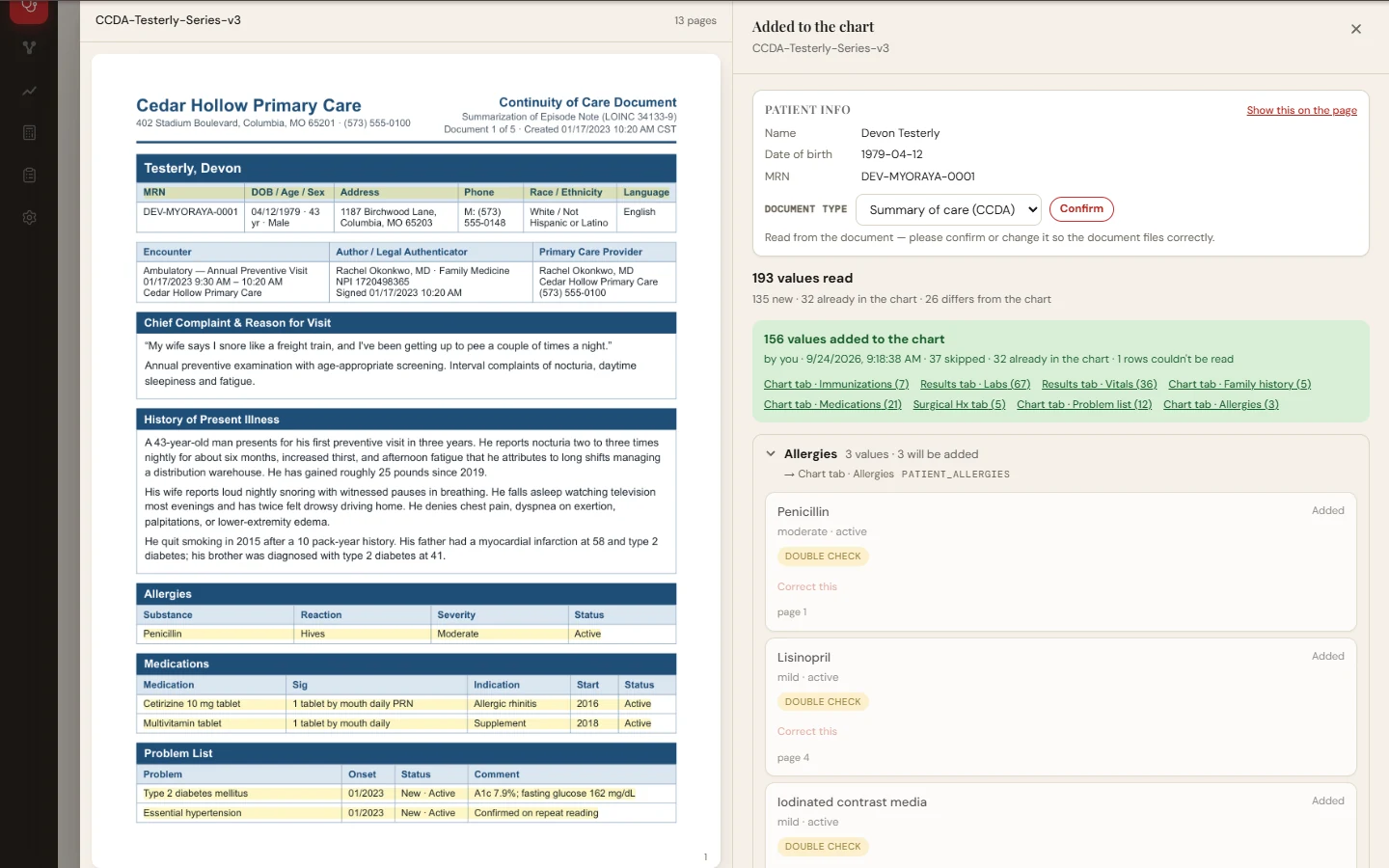
Read outside records into the chart.
Upload a care document and ORAYA separates what is new, what is already charted, and what conflicts, then waits for your confirmation before filing anything.
- Allergies, medications, problems, labs, and vitals
- New, existing, and conflicting values separated
- Each value traced to its page in the source
Auto Doc: from the visit conversation to a signed note.
Auto Doc listens during the visit, turns the conversation into structured documentation, and hands it to the clinician to review and sign. The patient agrees first, every time.
Consent comes first
Before recording starts, the clinician confirms the patient was told about and agreed to AI-assisted documentation. Without that confirmation, the microphone stays off.
The conversation becomes structure
Live medical transcription fills in the fields a visit note needs, so documentation takes shape during the visit instead of after it.
The clinician reviews and signs
Nothing is final until the clinician has reviewed the report, confirmed it, and signed it by name. ORAYA records who signed and when.
Each source is tagged with its Oxford CEBM level, so the strength of the evidence is visible in every answer, not assumed.
For the people who need to stand behind the answer.
Clinical decision support at the point of care
Differentials and ranked treatment options, tailored to the patient and ready to document.
Request a demo →Drug interactions and formulary decisions
Interaction checks, contraindications, and head-to-head comparisons on efficacy and safety.
Request a demo →Medical literature synthesis at scale
Safety profiles and literature reviews, exported as fully cited PDF, DOCX, or Markdown reports.
Request a demo →Oraya Study. Study what you think you know.
A study companion for medical students and residents. Spaced repetition, cited vignette drills, and a Socratic tutor, all steered by the answers you were confident about and got wrong.
Recorded on the Oraya Study application with a demo learner account. The cases are fictional teaching vignettes.
Flashcards
Scheduled at the edge of forgetting.
Vignettes
Timed clinical vignettes, with every distractor explained and sourced.
Socratic
A tutor that asks before it tells, and can cite the material you upload.
Readiness
Mastery and confidence calibration by organ system, shown as readiness bands rather than a predicted score.
MyORAYA, the patient app connected to your clinic.
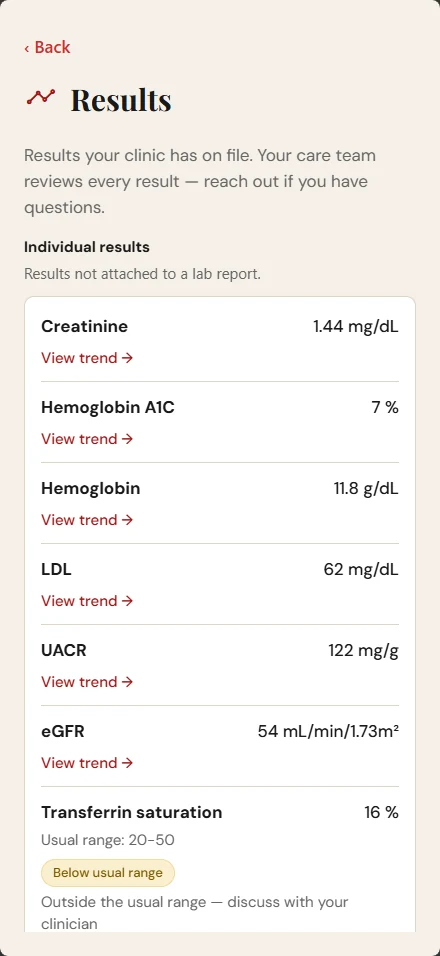
Alongside the clinician platform, ORAYA Health operates MyORAYA: the patient application through which you view the health record your clinic keeps, request appointments and medication refills, and message your care team.
Your record, in your pocket
Visits, medications, allergies, lab and imaging results, and documents from your clinic's record, with appointment and refill requests built in.
Secured by SMS sign-in codes
Patients who opt in receive one-time passcodes and account-security alerts by text message; the registered use case is Two-Factor Authentication. No marketing texts, ever.
Consent, documented
How texting works (opt-in, message samples, frequency, rates, and STOP/HELP) is published openly on our SMS program page, with the full detail in our Privacy Policy.
Connect your Google Fitbit
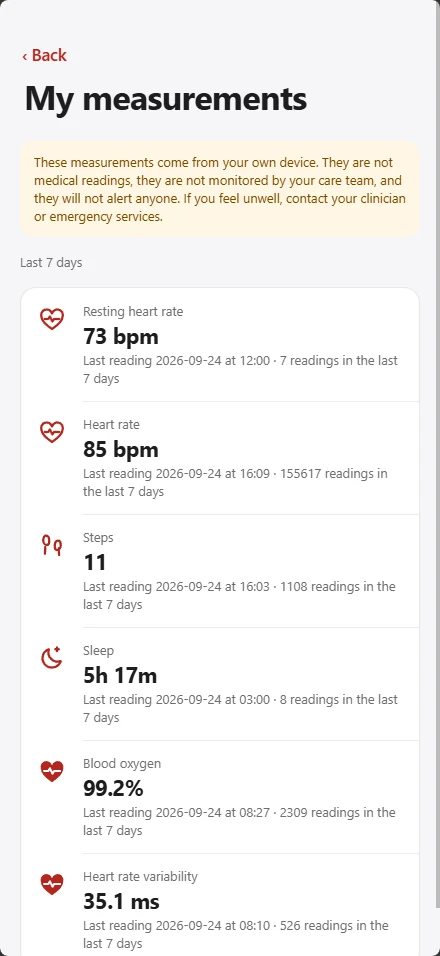
Link a Google Fitbit through your Google account to see heart rate, sleep, steps, and more beside your record. Access is read-only, and you can disconnect at any time. How we handle this data is in our Privacy Policy.
Questions, answered.
What is ORAYA?
ORAYA is an explainable clinical AI platform for healthcare professionals. It answers dosing, safety, and treatment questions and links every point to the study, FDA label, or guideline it came from.
Where does ORAYA's evidence come from?
ORAYA draws on more than 50 million peer-reviewed papers indexed across PubMed, OpenAlex, and Semantic Scholar, plus FDA adverse event reports (FAERS), drug labels, recalls, and shortages.
How does ORAYA grade evidence?
Each cited source is tagged with its Oxford Centre for Evidence-Based Medicine (CEBM) level, from systematic reviews to expert opinion, and citations are checked as supporting, tangential, or unsupported.
Who is ORAYA for?
ORAYA is built for physicians and clinicians, pharmacy and PBM teams, and clinical researchers. It supports, but does not replace, clinical judgment.
What is Auto Doc?
Auto Doc is ORAYA's AI-assisted visit documentation. After the clinician confirms the patient agreed to it, Auto Doc transcribes the visit and drafts structured documentation such as the visit note. The clinician reviews and signs every report before it is final.
What is Oraya Study?
Oraya Study is ORAYA's education product for medical students and residents preparing for exams such as USMLE Step 1, Step 2 CK, COMLEX, and shelf exams. It combines spaced-repetition review, cited vignette drills, and a Socratic tutor. It is in early access; email us to request an invitation.
Can I connect a Google Fitbit to MyORAYA?
Yes. On the Devices screen in MyORAYA you can connect a Google Fitbit through your Google account. ORAYA reads measurements such as heart rate, sleep, and steps, read-only, and you can disconnect at any time. Readings are not monitored in real time. Details are in our Privacy Policy.
What is MyORAYA?
MyORAYA is the patient application operated by ORAYA Health. Patients use it to view the health record their clinic keeps, request appointments and medication refills, and message their care team. Details of SMS sign-in are on our SMS program page.
See ORAYA on your questions.
A walkthrough with our team, on the clinical questions you work with every day.